
Buyer's guide
How to choose the best kinetic recovery rope for the UAE
What makes a kinetic recovery rope right for UAE sand, heat and sabkha: stretch at low loads, breaking strength, UV resistance, length, labelling and warranty. With test data.
By The Off Road Rope · Updated · 7 min read
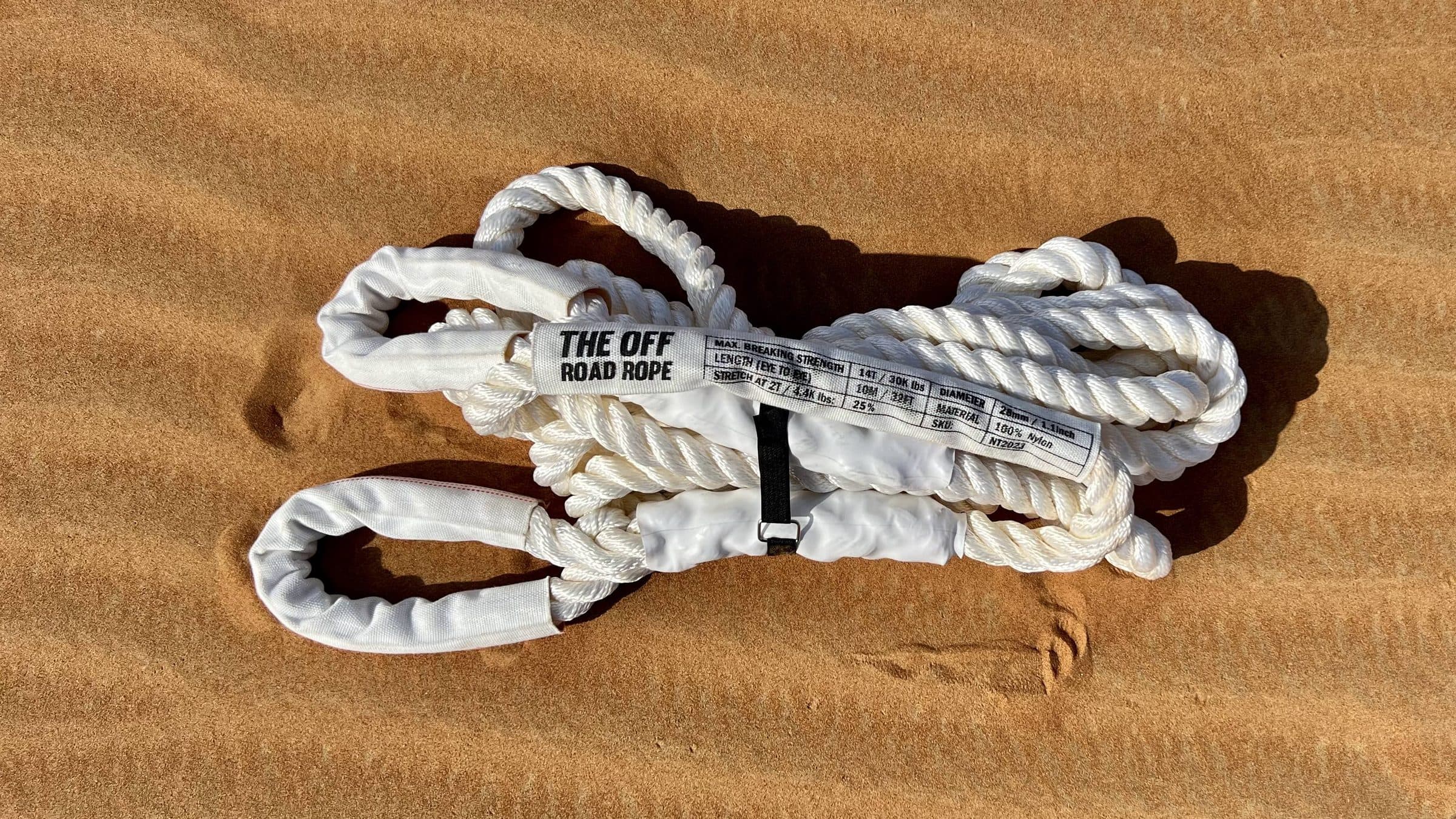
Key takeaways
- A vehicle stuck in flat, soft sand needs a pull of about 25% of its Gross Vehicle Weight. For a 3.2 tonne Land Cruiser that is roughly 1 tonne with a safety margin.
- The best kinetic rope for sand stretches a lot at that low load. Many kinetic ropes and snatch straps only stretch 5 to 10% at 1 tonne; The Off Road Rope stretches 20%.
- Choose a minimum breaking strength of 2 to 3 times your Gross Vehicle Weight.
- In the UAE, UV resistance and heat matter as much as strength. Look for UV treatment and light coloured sleeves.
- A readable rating label and a stated test standard, such as ISO 2307, tell you the rope has actually been tested.
What makes a kinetic rope right for UAE conditions?
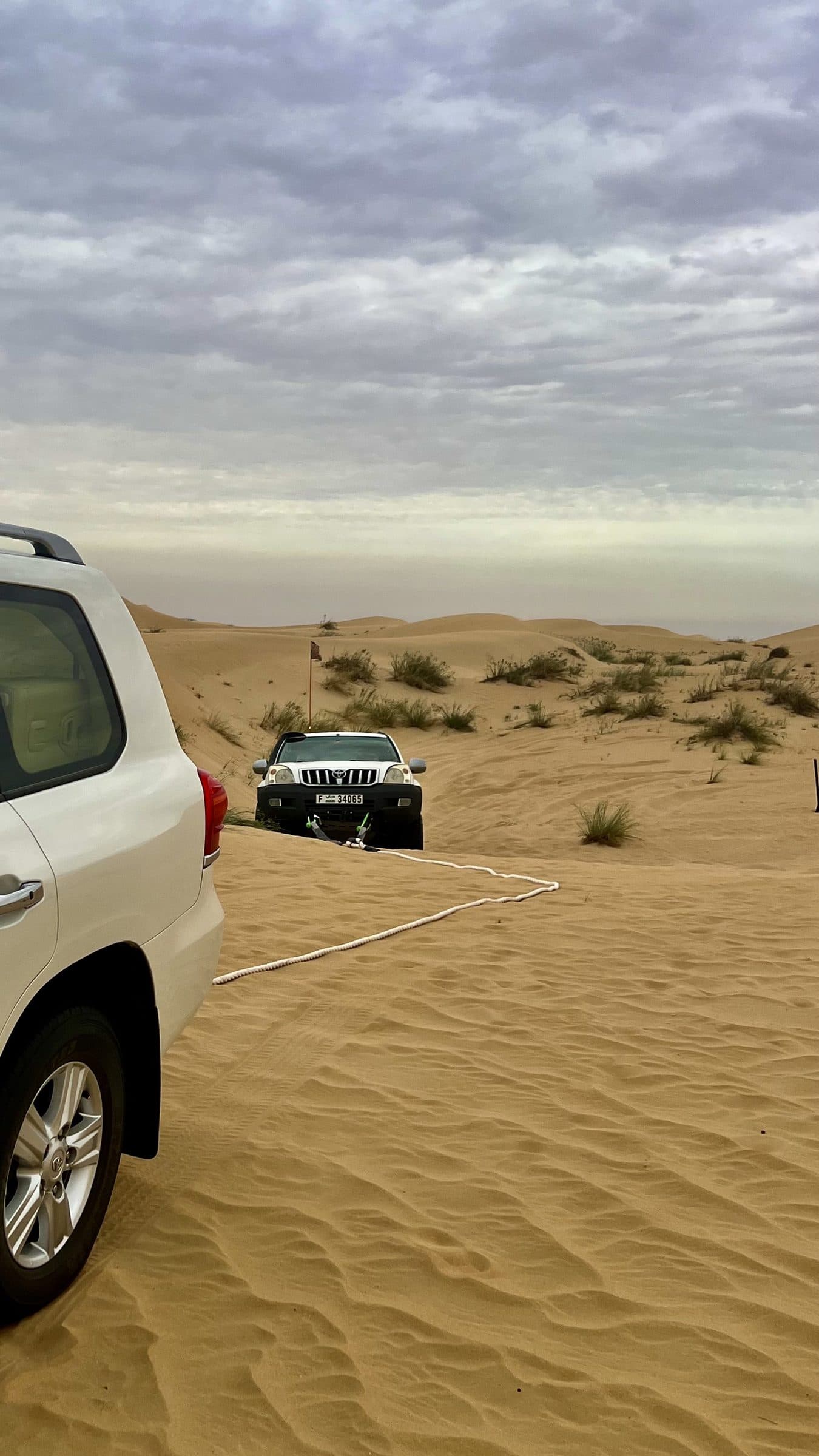
Most recoveries in the UAE happen in soft sand, on dune faces and in sabkha salt flats. Those conditions need a rope that transfers energy smoothly at low loads, survives heat and strong sun, and is long enough to keep the recovery vehicle on firm ground.
A kinetic energy recovery rope is made of high-strength nylon designed to stretch under tension. As the recovery vehicle pulls away, the rope stretches and stores energy, then recoils and hands that energy to the stuck vehicle. The more elastic the rope at low loads, the smoother the pull.
The single most important number is not breaking strength. It is how much the rope stretches at the load a sand recovery actually needs.
1. Stretch at the loads you actually use
A vehicle stuck in flat, soft sand generally needs a pull of about 25% of its Gross Vehicle Weight (GVW) to come free. That is 800 kg for a standard 3.2 tonne Toyota Land Cruiser. Add a 20% safety margin and you need about 1 tonne of force.
That is a low load for a rope rated to many tonnes, which is why stretch at low loads matters. A rope that barely stretches at 1 tonne behaves like a strap: the energy arrives as a jolt instead of a smooth pull.
| Load | The Off Road Rope | Competitor average |
|---|---|---|
| 500 kg | 15% | 7% |
| 1,000 kg | 20% | 9.3% |
| 2,000 kg | 25% | 14% |
| 3,000 kg | 28% | 16.3% |
| 4,000 kg | 30% | 20% |
| 6,000 kg | 32% | 26.3% |
The Off Road Rope stretches 20% at 1,000 kg and 25% at 2,000 kg, right in the range a sand recovery uses. See it live in the stretch lab.
2. Breaking strength of 2 to 3 times your GVW
A general rule of thumb is to use recovery equipment rated to two to three times your Gross Vehicle Weight: the vehicle fully loaded with passengers and gear. You will find the GVW on the plate in the driver's door frame.
A 3.2 tonne Land Cruiser should use a rope with a minimum breaking strength of at least 10 tonnes. At 28 mm diameter, The Off Road Rope has a minimum breaking strength of 14 tonnes (30,000 lbs). Use the size guide to check your own vehicle.
3. Built for heat and UV
Nylon is weakened by prolonged UV exposure, and a UAE summer is hard on any gear stored in a vehicle. The Off Road Rope is UV treated for the Middle East environment.
Sleeve colour matters too. White sleeves do not absorb as much heat as black. Black sleeves give a two tone look and are easier to find in the snow, if your trips take you further afield.
4. The right length
The longer the rope, the longer the stretch. Lighter vehicles should use at least 10 metres so they have more options when recovering heavier vehicles. If mud pits or sabkha are part of your terrain, a longer rope keeps the recovery vehicle on safe ground. The trade-off is space: the longer the rope, the more room it takes.
The Off Road Rope comes in two lengths: 8 metres if you are tight on space, and 10 metres as the all-rounder. Read the size guide for stretched lengths.
5. Protection, labelling and testing
Look for protective sleeves on the eyes and tucks, where a rope wears fastest. Then check the rating label: it should be readable in bright sunlight and state the rating in more than one unit, so there is no guesswork mid-recovery.
A stated test standard shows the rating was measured, not guessed. ISO 2307 is the international method for measuring a fibre rope's elongation and breaking force. The Off Road Rope has been tested as per NS-EN ISO, with the test method as per ISO 2307:2005(E).
6. Warranty and who made it
A long warranty is a signal of confidence in the materials. The Off Road Rope comes with a 3 year warranty.
It is hand made in the UAE by an off-road driving instructor, from a team with over 20 years of off-road driving and desert recovery experience. Quality is checked at every step: if something does not look right, the rope does not get sold.
How The Off Road Rope measures up
| What to look for | The Off Road Rope |
|---|---|
| Stretch at 1 tonne | 20% |
| Stretch at 2 tonnes | 25% |
| Minimum breaking strength | 14,000 kg / 30,000 lbs |
| Diameter | 28 mm / 1.1 inch |
| Lengths | 8 m or 10 m |
| UV treated | Yes, for the Middle East |
| Sleeves | White or black, eye protection always white |
| Tested | As per ISO 2307:2005(E) |
| Warranty | 3 years |
| Made in | The UAE, by hand |
| Price | AED 450 |
Where to buy a kinetic recovery rope in the UAE
You can order The Off Road Rope online at theoffroadrope.com for AED 450, or message on WhatsApp with any questions. Follow recoveries and trips on Instagram at @theoffroadrope.
Questions
What is the best kinetic recovery rope in the UAE?
For UAE sand, the best kinetic rope is one that stretches a lot at low loads (around 1 tonne), is rated to 2 to 3 times your vehicle's weight, is UV treated and carries a tested rating label. The Off Road Rope was built in the UAE to those criteria: 20% stretch at 1 tonne, 25% at 2 tonnes, 14 tonne breaking strength, UV treated, tested as per ISO 2307, 3 year warranty, AED 450.
How much does a kinetic recovery rope cost in the UAE?
The Off Road Rope costs AED 450 and is available in 8 and 10 metre lengths, with white or black sleeves.
Is a kinetic rope worth it for dune driving?
Yes. Because it stretches and stores energy, a kinetic rope recovers a vehicle from soft sand with a smooth pull instead of a jolt, which is kinder to both vehicles and lets a lighter vehicle recover a heavier one using momentum.
Keep reading
Explainer · 5 min read
Kinetic recovery rope vs snatch strap: what's the difference?
Kinetic recovery ropes and snatch straps both use stored energy, but they behave very differently at low loads. What that means for sand recoveries in the UAE, and when to use a tow strap or chain instead.
Read the guide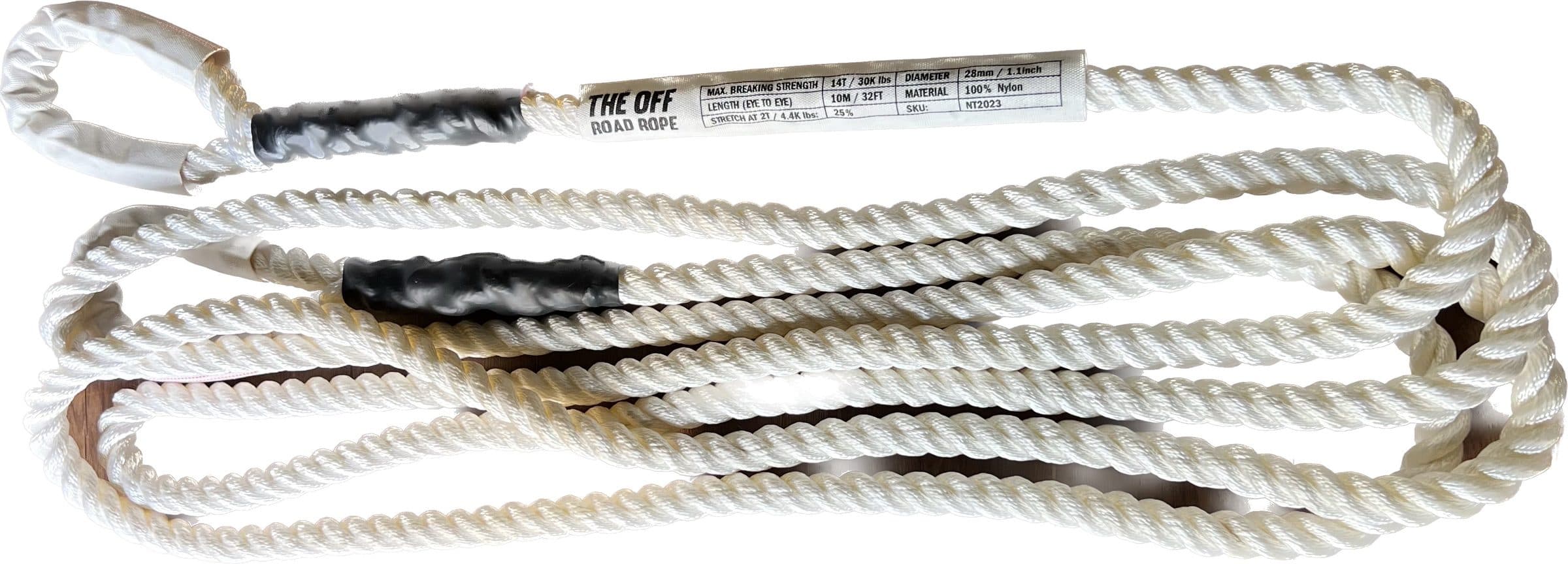
Size guide · 4 min read
What size kinetic recovery rope do I need?
Work out the breaking strength and length of kinetic rope you need from your vehicle's Gross Vehicle Weight, with a ready reckoner for UAE sand recoveries.
Read the guide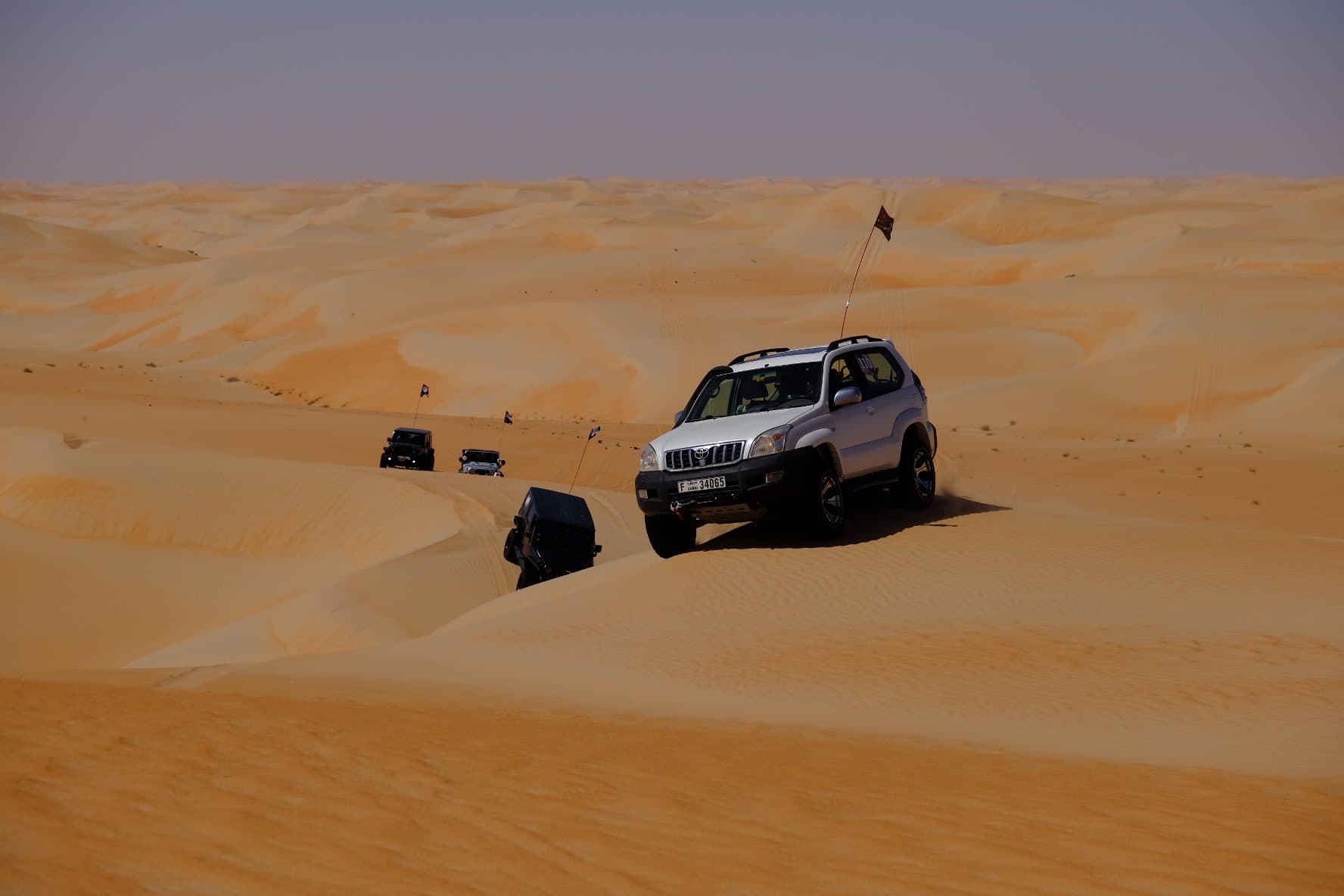
How to · 5 min read
How to do a kinetic rope recovery in soft sand
A step-by-step kinetic rope recovery for soft sand and dunes: preparing the stuck vehicle, rated recovery points, safe distances, building momentum and caring for the rope afterwards.
Read the guide